From investment explainers to original research
An update on my social media experiment
As the weeks pass, my experiment with TikTok and Instagram is becoming more ambitious. What began with relatively simple explanations of investment trusts has developed into topical commentary on market events and, most recently, original investment research, and my latest video is producing some interesting results.
From explaining to researching
My early videos focused on the basics: how investment trusts work, discounts to net asset value, ETFs and dividend smoothing.
I've since moved into more topical subjects, including HarbourVest Global Private Equity's tender offer and Saba's activism at Baillie Gifford US Growth Trust from within the investment trust sector.
The next step has been to develop my own research, rather than simply explain existing information.
For my most recent video, I wanted to explore a question about diversification: does combining different investment approaches within the same geographical markets make a meaningful difference to investment outcomes?
Three portfolios, 25 years
I constructed three hypothetical portfolios, each starting with £10,000 at the beginning of 2001, and compared their performance through to the end of 2025.
Portfolio A: A single global equity index, the MSCI All Country World Index.
Portfolio B: Six equally weighted regional indices, rebalanced annually.
Portfolio C: The same regional allocations, but with half invested in index trackers and half in investment trusts offering complementary approaches.

The investment trusts were selected for their long histories and complementary investment strategies, rather than by ranking their historical returns.
The results were striking.
Portfolio | Value after 25 years |
Global index | £61,954 |
Regional indices | £58,363 |
Regional indices + investment trusts | £91,901 |

The mixed portfolio finished substantially ahead. It also experienced the smallest maximum monthly-observed peak-to-trough fall of the three portfolios, although it certainly wasn't the least volatile in every period.
This doesn't establish that investment trusts outperform index trackers. The exercise has important limitations about which it is important to be honest. These limitations include survivorship bias, historical data constraints and the impact of the particular trusts selected. Different choices could have produced very different results.
But for my audience, it provides an interesting illustration of how diversification can involve investment approaches as well as geographical exposure.
Developing the research meant assembling historical data, settling portfolio construction assumptions, considering the limitations and then finding a way to explain the findings in an accessible video. All of this is a significantly larger undertaking than my earlier direct-to-camera investment explainers.
An unexpected audience response
The finished video runs for 2 minutes and 22 seconds. I suspected it might be too long and technical for social media.
Its initial reception on TikTok seemed to support that concern, although technical playback problems complicated the first upload.
Instagram has told a different story. At the latest snapshot, the portfolio video had received 1,451 views on Instagram, making it my second most viewed video there, compared with 497 views across its two TikTok uploads.
My video about the HarbourVest tender offer has shown a similar contrast, with 1,806 views on Instagram against 780 on TikTok.
Across the 16 videos I've published on both platforms, TikTok still leads comfortably in overall viewing figures. But these two recent videos have performed substantially better on Instagram.
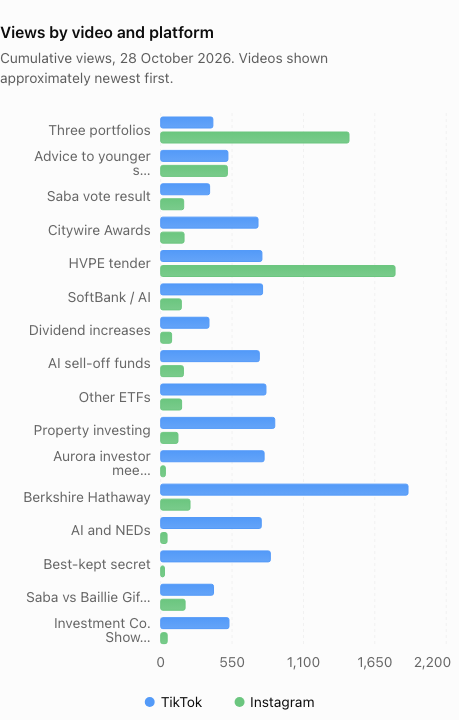
The accompanying chart shows the results across all 16 videos. These are cumulative views, not comparisons adjusted for how long each video has been available, and the numbers remain relatively modest.
What am I learning?
I'm increasingly convinced that the experiment is worth continuing, not least because the results keep challenging my assumptions.
The content is becoming more sophisticated, but that hasn't necessarily made it less accessible or less interesting to viewers.
I'm also discovering that identical videos can receive very different responses on TikTok and Instagram. I'm not yet sure why, and it's far too early to draw definitive conclusions about either platform.
Perhaps the most useful lesson is simply not to underestimate the appetite for substantive investment content, even on platforms that aren't traditionally associated with detailed financial analysis.
The next challenge is to continue developing the quality of the research while becoming better at communicating it. You can follow my content on:
Instagram - instagram.com/alextheinvestmenttrustguy
This is an educational historical illustration, not investment advice. Past performance is not a reliable indicator of future returns. The research includes selected surviving investment trusts and other methodological assumptions that affect the results.


Comments