Paddling Past Our Maritime Past: Why Hands-On Trusteeship Requires Getting Your Hands Wet
By Alexander Denny
A whiteboard in a climate-controlled boardroom is a comfortable place to design a charity's strategic plan. But as a fiduciary, you cannot truly understand the assets, the community, or the mission you protect if you only experience them through quarterly board packs. True stewardship requires active, visible curiosity.
Sometimes, it also requires paddling 44 nautical miles (50miles) along a wind-swept coastline, fighting a punishing head sea, and occasionally getting flipped upside down by a passing bow wave.
Earlier this month, between the 6th and 9th of July, I set out from my home in Brighton to kayak unsupported to the Nautical Archaeology Society (NAS) headquarters at Fort Cumberland, Portsmouth. The South Coast Shipwreck Heritage Paddle was designed as a physical challenge, a personal passion project, and—most importantly—an effort to raise vital unrestricted funding for a charity I have had the privilege of serving as a Trustee for the past eight years.

Here is what four days on the water taught me about the reality of our underwater heritage, and why "presence" is the most valuable asset a trustee can bring to the table.
1. The Power of "Paddling Past Our History"
For as long as I can remember, I have been captivated by two things: history and the sea. Maritime archaeology is the unique intersection of those passions. Shipwrecks are extraordinary, fragile time capsules. Unlike land-based ruins, they preserve singular moments of human exploration, trade, and tragedy in a pristine state.
Paddling slowly along the south coast under my own power offered a profound shift in perspective. I wasn't just traversing open water; I was literally paddling past our maritime history.
My route took me over some of the UK's most significant and vulnerable protected wreck sites:
The resting place of the Klein Hollandia, a 17th-century Dutch warship lying in the depths of the Sussex coast.
The historic Holland 5 submarine.
The protected remains of The Hazardous and the A1 submarine near the Solent.
To dive these sites is one thing, but to travel the coastline that claimed them—feeling the exact same currents and winds that tested those historic crews—brings an unmatched operational understanding of the physical environment our charity operates in.
2. Physical Grit and Boardroom Governance
The expedition was a stark reminder that nature does not care about your strategic timelines.
Day 1 was a brutal introduction. Strong head winds and a highly disorganized, choppy sea along the Sussex coast made progress painfully slow and physically exhausting. At one point, as I rested on an exposed shingle beach, a Coastguard officer approached me just to check on my safety. It was a humbling moment, but it underscored a key truth: whether you are navigating a kayak through a force 5 headwind or steering a financial institution through a macroeconomic storm, you have to respect the elements, monitor your reserves, and adjust your headings accordingly.
And then, of course, there was the drama off East Preston.
Throughout the entire 50-mile journey, I kept every single piece of my safety and photographic equipment securely tethered to my deck. Yet, off East Preston, the water cleared beautifully. I spotted shallow reef pinnacles covered in soft, waving corals. Entranced by the view, I did what any passionate marine advocate would do: I unclipped my underwater camera for the first and only time to slide it beneath the surface for a photograph.
At that precise second, a heavy bow wave from a passing boat—which I hadn't even heard over the wind—hit my kayak laterally.
In an instant, I was upside down. While my rolling drills held and I recovered safely, the camera (and the spectacular underwater footage) was claimed by the sea. It was a classic, self-deprecating reminder that the sea always demands respect—and that in both diving and corporate governance, the moment you unclip your safety lines is the exact moment the unexpected wave hits.
3. The Unsung Value of Unrestricted Funding
While the challenge was a deeply personal passion project, its primary goal was to secure unrestricted funding for the Nautical Archaeology Society.
As a Trustee, I am acutely aware of a structural challenge shared by almost every charity in the UK: we are excellent at raising money for specific, shiny projects, but raising funds for the day-to-day running, maintenance, and administrative backbone of a charity is incredibly difficult.
Unrestricted funds are the hardest pounds to secure, yet they are the most valuable. They represent the "working capital" of the third sector. They allow us to:
Keep the lights on and maintain our operational headquarters at Fort Cumberland.
Maintain our dive club RIB, Honor, ensuring our volunteer divers can access sites safely.
Rapidly deploy resources to protect vulnerable, newly exposed foreshore wrecks before they are lost to coastal erosion.
Fund the training and education of the next generation of amateur maritime archaeologists.
By undertaking an unsupported, grueling physical challenge, my goal was to galvanize our community, capture people's imagination, and encourage them to fund the unglamorous but essential operational bedrock of the NAS.
Delivering on the Promise
I am incredibly proud to share that, thanks to the immense generosity of over 60 supporters, we have successfully achieved our initial funding goals, raising more than £2000 of much-needed funds that will go directly to work supporting our volunteers and heritage preservation programs.
To everyone who donated, shared the campaign, or sent words of encouragement while I was nursing sore muscles and blisters: thank you.
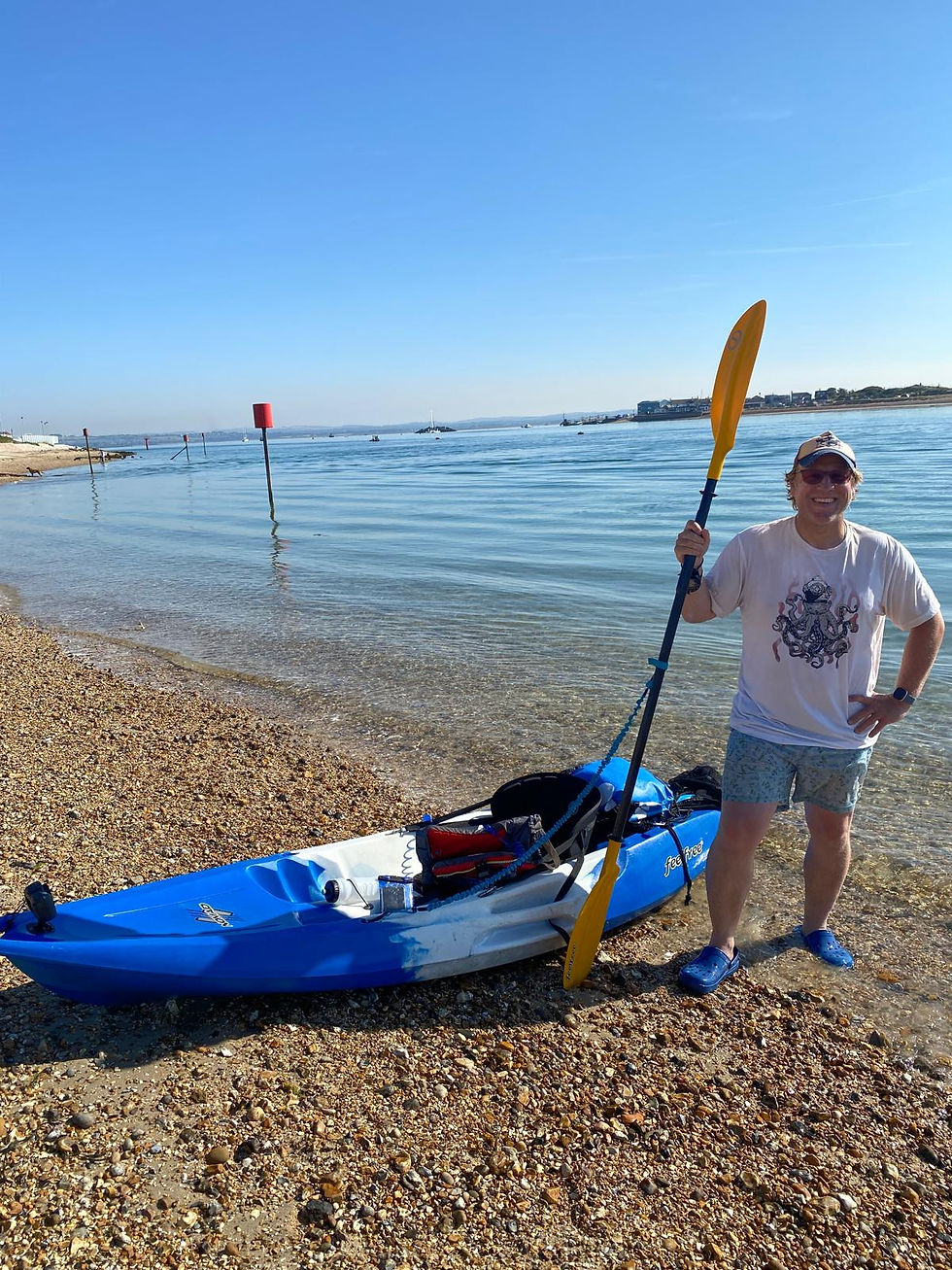
This paddle was a powerful reminder that effective governance is not passive. As trustees, non-executive directors, and fiduciaries, we must remain present in the spaces we govern. We must be willing to get our hands wet, experience the operational realities firsthand, and occasionally take a plunge to protect the things we are passionate about.
The Nautical Archaeology Society’s Crowdfunder remains open until the end of July. If you’d like to support our ongoing mission to protect the UK's underwater history, you can read more and donate at the link below:
Keywords: Nautical Archaeology, Charity Fundraising, Maritime Heritage, Volunteer Diving, Unrestricted Funding, Active Governance, South Coast Kayaking, Shipwrecks


Comments